
Doping Quantum Dot Lasers Helps Them Release Light More Efficiently
source:Photonics
release:Nick
keywords: Doping quantum dots laser
Time:2017-11-18
LOS ALAMOS, N.M., Nov. 17, 2017 — Doping quantum dots (QDs) with additional electrons has been found to cause the specially designed QDs to produce laser light with less stimulation and less energy loss.
By adding extra charge carriers to their QDs, researchers from Los Alamos National Laboratory’s Nanotech Team were able to block absorption and create a state of transparency without external stimulation, reducing the optical-gain threshold to virtually zero.
When photodoping was applied to specially engineered quantum dots with impeded Auger decay, the QDs showed a considerable reduction of the optical gain threshold due to suppression of ground-state absorption by pre-existing carriers.
Moreover, by injecting approximately one electron per dot on average, the researchers achieved a more than twofold reduction in the amplified spontaneous emission threshold, bringing it to the sub-single-exciton level. According to researchers, these measurements indicate that ‘zero-threshold’ gain is achievable by completely blocking the band-edge state with two electrons.
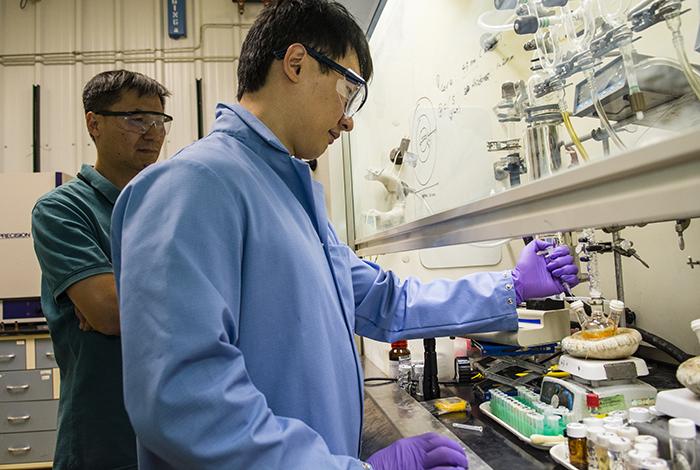
Los Alamos National Laboratory Chemist Jaehoon Lim works on an apparatus that synthesizes quantum dots along with Los Alamos researcher Young-Shin Park (also with the University of New Mexico Center for High-Technology Materials). Los Alamos colleagues Kaifeng Wu and Victor Klimov worked with Lim and Park to demonstrate that negatively charged quantum dots show promise for low-power laser applications or quantum dot laser diodes. Courtesy of Los Alamos National Laboratory.
”When we properly tailor the compositional profile within the particles during their fabrication, and then inject two or more electrons in each dot, they become more able to emit laser light. importantly, they require considerably less power to initiate the lasing action,” research team leader Victor Klimov said.
This research also introduces a new type of QDs, which have interiors designed to maintain the lasing-active state for a much longer time than standard particles.
Typically, the presence of extra electrons would suppress lasing because QD energy would be quickly released not as a photon stream but as wasted heat. The new Los Alamos particle design eliminates these parasitic losses, redirecting the particle’s energy into the emission channel.
“These studies open exciting opportunities for realizing new types of low-threshold lasing devices that can be fabricated from solution using a variety of substrates and optical cavity designs for applications ranging from fiber optics and large-scale lasing arrays to laser lighting and lab-on-a-chip sensing technologies,” said Klimov.
 Surges Sharply at Opening! Han's CNC Successfully Listed on the Hong Kong Stock Exchange
 Hesai Partners With Grab to Accelerate LiDAR Deployment Across Southeast Asia
 New Year Windfall: 5 Laser Manufacturers Secure Nearly 100 Million Yuan in Government Subsidies
 2026 Laser Industry Breakthrough: Insights from Five Top Industry Leaders
 GBA High-Standard Summit Addresses Four AI+Laser Welding Core Propositions
 Li Qi from Sichuang Laser: Pioneering High-Power Laser Tech for New Cross-Industry Use Cases
 Awardee Chen Weibiao Pushes Space Laser Tech to Build China's Aerospace Leadership
 Father of Shenguang Facility: Building Three Generations of National Strategic Equipment
 LASERVALL's Li Mengmeng: A Leader in Laser Solder Ball Welding, Deep in Automated Niche Sectors
 Intelligent Scientific Systems: Leading Domestic Ultrafast Imaging, Redefining Visual Perception